Introduction
AI coding agents are becoming capable of navigating repositories, tracing dependencies, and modifying code across multiple files. When applied to legacy systems, this capability promises to reduce engineering time, but it also introduces new risks. Legacy code often carries decades of business decisions, undocumented workarounds, and historical context that no longer appears in comments or documentation.
What Happened
Modern AI agents can read code, run tests, and iterate toward a result without human intervention after every step. Give a well-structured codebase and a clear task, and an agent can accomplish in minutes what once required hours of jumping between an IDE, documentation, and a terminal. However, legacy software presents a different environment. Older systems accumulate a backlog of updates, missing tests, incomplete documentation, and small bugs that developers avoid because the original authors are no longer available.
Many modules survive only because teams are afraid to touch them. Some parts are written in frameworks with declining adoption, while others contain conditions that reference long-dead customer contracts or regulatory requirements that exist outside the repository.
Why This Matters
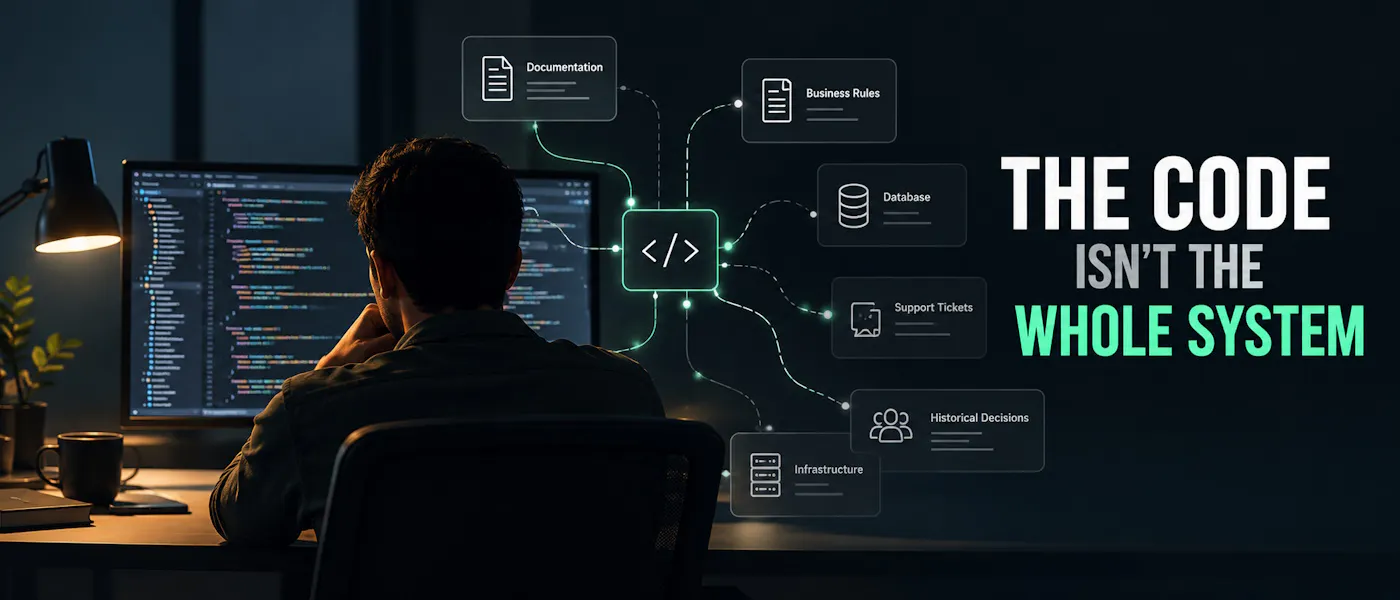
The core challenge is that an AI can understand syntax without understanding intent. An agent may correctly parse a function and still make an engineering decision that breaks a business process because the reasoning behind a condition lived in a meeting room, a support ticket, or a production incident from six years ago. Legacy systems are full of invisible dependencies technical and organizational. An agent with access only to the repository has excellent code context but poor system context, which can lead to costly mistakes.
When an agent encounters a hard-coded limit, an unusual conditional, or a defensive function, it cannot easily distinguish between accidental complexity and intentional business logic. Without the why, autonomous maintenance becomes risky.
Key Takeaways
- Archaeology before engineering. Before asking an agent to refactor, assign it investigation work: map callers, identify database tables, locate configuration flags, find related tests, and inspect version history. The goal is to expose uncertainty, not produce a patch.
- Git history as context. Old commits and pull requests often contain the reasoning behind code that looks unnecessary today. A commit message explaining why a condition was added can prevent a regression that reappears years later.
- Documentation of decisions, not syntax. Docs that repeat what a function signature already says add little value. More useful are notes explaining why a rule exists, migration summaries, and incident records that connect technical behavior to business requirements.
- Risk-tiered autonomy. Not all maintenance tasks should carry the same level of agent autonomy. Low-risk work includes documentation updates, dead-code investigation, and formatting changes. Medium-risk involves isolated bug fixes and dependency upgrades under strong tests. High-risk areas such as authentication, billing, schema changes, and poorly tested critical modules require human oversight.
- Small, verifiable changes. A boring seven-line fix is often safer than a broad refactor that touches many interdependent areas. Ask the agent to explain which behavior will change and which will remain untouched.
Production feedback loops also matter. A change can pass every test and still alter behavior that the suite never captured, especially in systems with old customer-specific paths. Feature flags, staged rollouts, and careful metric monitoring reduce exposure. Reversibility should be designed before an agent acts, not discovered after an unexpected result.
Conclusion
AI agents can read legacy code, but they cannot easily read the history behind it. The most effective use of AI in brownfield maintenance treats the agent as a fast software archaeologist: mapping what the code does, surfacing where assumptions live, and flagging areas that need human judgment. Teams that invest in preserving engineering history, documenting business decisions, and tiering agent autonomy will get the most value while minimizing risk. Ultimately, the goal is not to have an agent rewrite the most code, but to ensure that every change is understood, verifiable, and safe.

Discussion
Join the conversation
Thoughtful reactions, questions, and follow-up ideas help shape the next story.