Introduction
The Bank of Industry (BOI) hosted its second Sustainability Conference in Lagos on 17 November 2026, gathering government officials, development partners, lenders, and private-sector leaders. Centered on the theme "Green, Resilient, Profitable: Redefining Nigerian Businesses for a Sustainable World," the event focused on how Nigerian companies can adopt environmental, social, and governance principles without sacrificing competitiveness or profitability.
What Happened
BOI Managing Director and CEO Dr Olasupo Olusi opened the conference by framing sustainability as a response to rising energy costs, climate-related disruptions, resource constraints, and shifting global market expectations. He argued that efficiency, resilience, and profitability are interconnected goals that will determine the future of Nigerian industry.
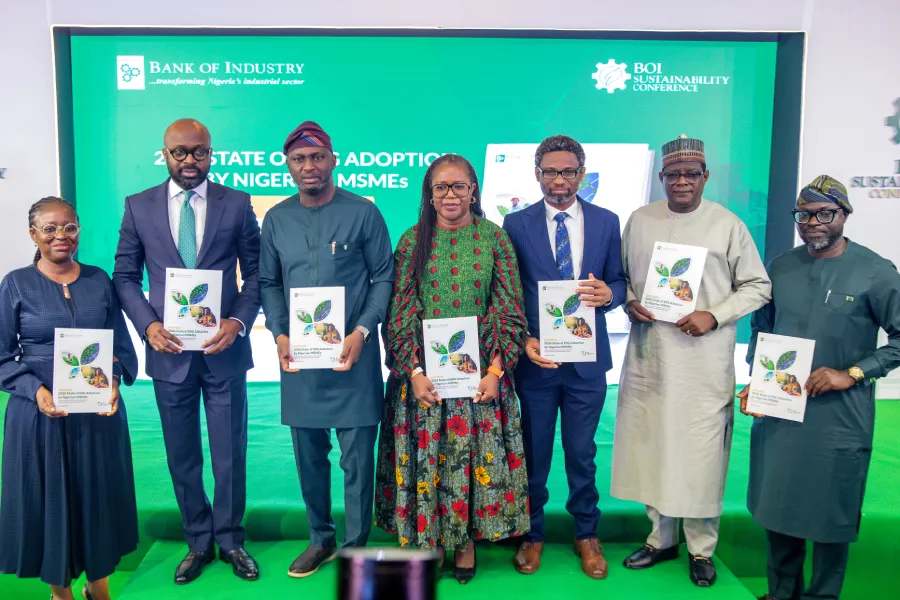
The conference featured fireside chats, masterclasses, and panel discussions designed to give participants practical tools for putting sustainability into practice. Organizers also unveiled the second edition of the State of ESG Adoption Report, produced in partnership with the Lagos State Business School, offering data-driven insight into how Nigerian businesses are integrating ESG considerations.
Dr Christopher Isokpunwu, Permanent Secretary at the Federal Ministry of Industry, Trade and Investment, described sustainability as a business imperative that affects access to capital, operational efficiency, market access, and long-term competitiveness. He urged BOI to expand green financing and technical support while ensuring small and medium-sized enterprises are not left behind.
Jackie Amprou, Nigeria Country Manager for Agence Française de Développement (AFD), discussed the Transforming Financial Systems for Climate programme. The initiative pairs a €100 million non-sovereign credit facility—co-financed by AFD and the Green Climate Fund—with a €2.5 million technical-assistance grant to strengthen BOI's climate strategy, risk management, and capacity to finance eligible mitigation and adaptation projects.
BOI also highlighted its broader climate work. As Nigeria's first implementing entity accredited by the Adaptation Fund, the bank can access up to US$25 million for nationwide adaptation projects. Its Solar Energy Programme is expanding clean energy access in rural and commercial areas, and BOI has already financed Nigeria's first 11 MW solar power plant for a steel manufacturer.
Why This Matters
Nigeria's goal of building a $1 trillion economy depends on industries that are productive, innovative, resilient, and globally competitive. For manufacturers facing high energy costs and reliance on alternative power, investments in renewable energy and energy-efficient equipment can lower operating costs while protecting profit margins. Agribusinesses that adopt circular production and waste reduction can strengthen local value chains.
Under its 2025–2027 strategy, BOI has pledged that no less than 10 percent of its financing interventions will support climate- and sustainability-focused projects, spanning renewable energy, climate-smart agriculture, and energy-efficient manufacturing. Partnerships with organizations such as GIZ and the Africa Guarantee Fund are intended to help mobilize climate finance and reduce barriers for businesses seeking green investment.
Key Takeaways
- The second BOI Sustainability Conference took place in Lagos on 17 November 2026 under the theme "Green, Resilient, Profitable."
- BOI pledged to direct at least 10 percent of its 2025–2027 financing interventions toward climate and sustainability projects.
- The second State of ESG Adoption Report was launched with the Lagos State Business School.
- A €100 million credit facility and €2.5 million technical-assistance grant from AFD and the Green Climate Fund will support climate mitigation and adaptation.
- BOI is Nigeria's first Adaptation Fund-accredited implementing entity and has financed an 11 MW solar plant for a steel manufacturer.
- Stakeholders emphasized that SMEs must be included in the green transition through expanded financing and technical support.
Conclusion
The BOI Sustainability Conference 2026 made clear that sustainability is no longer optional for Nigerian businesses—it is a condition for accessing capital, remaining competitive, and building long-term resilience. By combining targeted financing, credible ESG data, and international partnerships, BOI and its stakeholders aim to turn Nigeria's green industrial transition into a commercially viable reality.
Discussion
Join the conversation
Thoughtful reactions, questions, and follow-up ideas help shape the next story.