Introduction
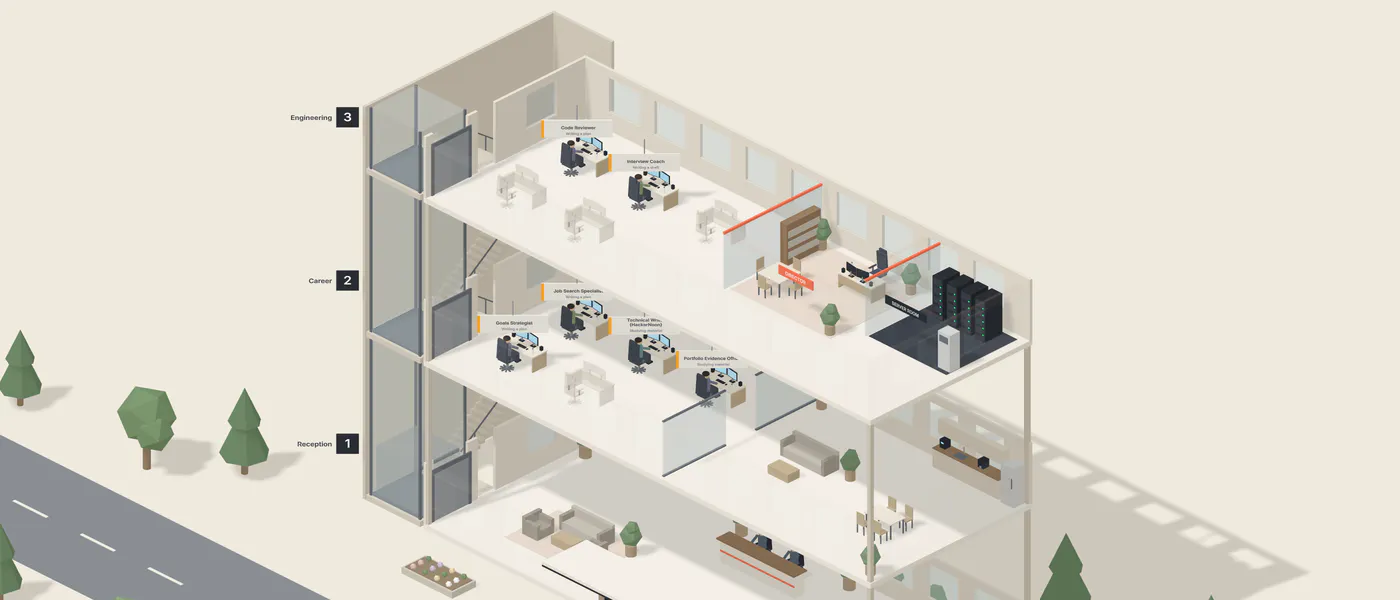
I designed a 3D isometric office where each on-screen figure represents a local AI agent running on a single graphics card. The visualization transforms abstract LLM activity into a viewable scene, making it easy to track which agent is working, waiting, or finished.
What Happened
The application uses a fixed agent pipeline: plan, research, draft, and self-check. Powered by Ollama and the 27B Qwen model on a single 24GB RTX 4090, each task pulls from a local SearXNG search when needed. The frontend combines Next.js 15, React Three Fiber, and Zustand, while the backend runs FastAPI with PostgreSQL as the single source of truth. State flows unidirectionally from database through the API into the browser store, then renders into the 3D scene. I developed the project in roughly three days, across eight stages, with 70 commits, 270 backend tests, and 41 layout checks by version 1.0.
Why This Matters
Seeing agent activity in real time reveals bottlenecks that chat interfaces hide. When multiple agents compete for the GPU, they queue, and a virtual coffee machine makes the wait visual, an agent that lingers over 30 seconds stands at the machine, representing the GPU queue. Rendering optimizations like instancing brought draw calls down from 893 to 117 while expanding the triangle count to 64k, keeping frame budgets under 2ms. The office concept makes the workflow tangible, highlighting where human attention is actually required.
Key Takeaways
- A single RTX 4090 can host a 27B parameter model, sharing GPU time across multiple local agents through queued inference.
- PostgreSQL serves as the sole source of truth for agent positions, task status, and timestamps, syncing consistently across reloads and multiple browser tabs.
- The coffee machine visualizes GPU contention: an agent waiting more than 30 seconds walks to the machine, making queue latency immediately apparent.
- Instanced mesh rendering reduced draw calls from 893 to 117 while scaling the triangle count from 13k to 64k, with CPU frame time p99 under 1.7ms.
- A two-stage self-check and explicit system prompt rules block the model from hallucinating personal details, dates, or experience not in the director's profile.
Conclusion
The 3D office demonstrates that visualizing local AI workflows doesn't require rendering overhead, it just needs transparent state and honest model behavior. Human oversight remains the final checkpoint: I approve the output, catch what the self-check misses, and determine when a task is complete. The project confirms that single-GPU, local AI setups are viable for prototyping and the patterns postgres-backed state deterministic pipelines visible queues scale as multi-agent systems evolve.






Discussion
Join the conversation
Thoughtful reactions, questions, and follow-up ideas help shape the next story.