Introduction
AI-assisted development accelerates shipping code, but AI-generated content often contains hidden architectural flaws that compile and pass linting while quietly violating module boundaries, state machine logic, and established architectural rules.
What Happened
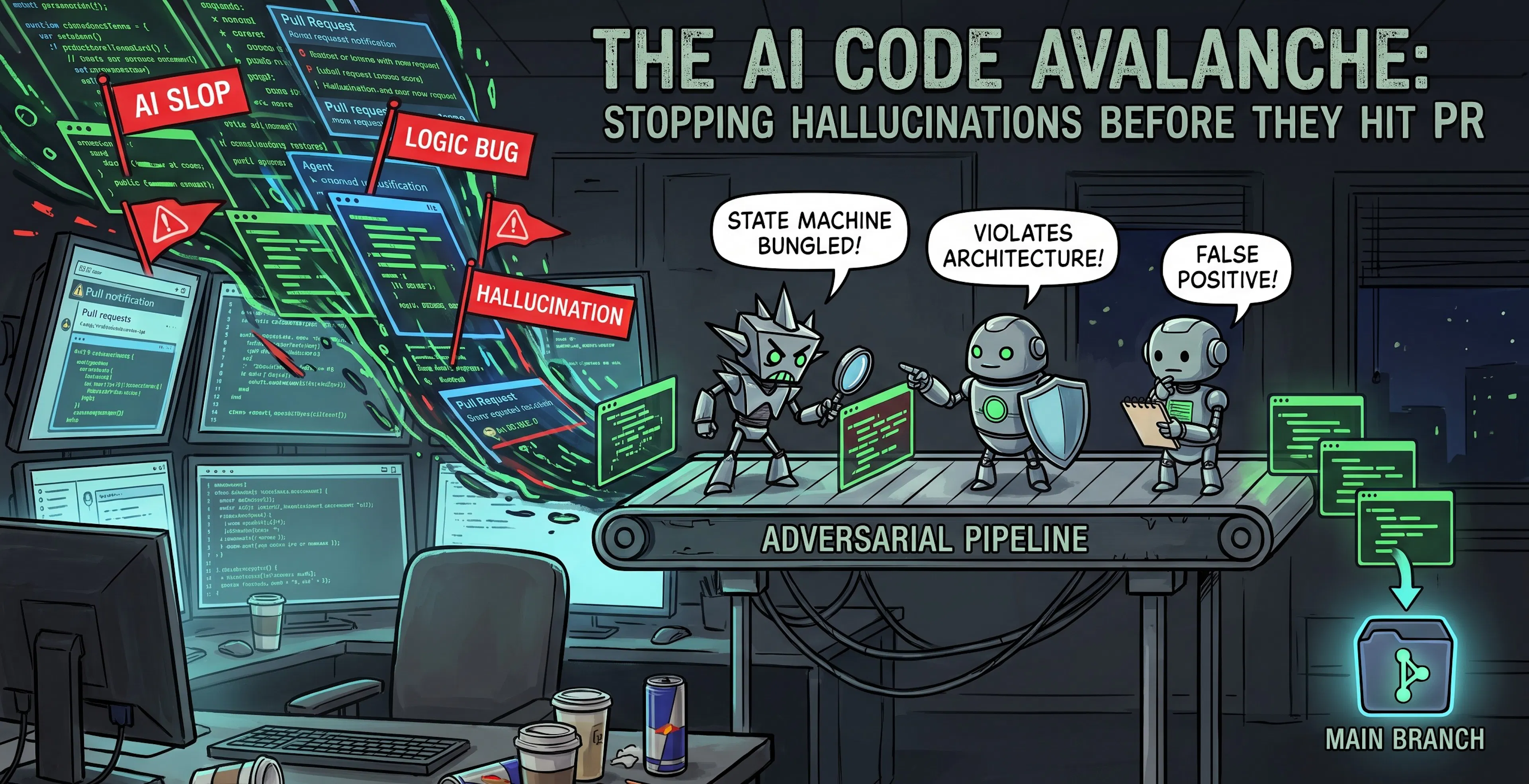
Senior engineers are overwhelmed by pull requests filled with AI-generated slop—code that appears functional but introduces subtle defects downstream. The author experienced this friction firsthand, spending excessive time acting as syntax police on every merge, which motivated building a systematic adversarial pipeline to catch problematic code before it enters the repository.
Why This Matters
Without systematic filtering, AI-generated code becomes architectural debt, forcing senior reviewers to manually hunt for subtle state bugs and boundary violations. This wastes valuable review time and erodes trust in AI outputs as reliable force multipliers for engineering velocity.
Key Takeaways
- Shift left by embedding architectural context via .cursorrules and claude.md, then enforce with deterministic pre-commit hooks that run linting and formatting before any LLM invocation.
- Implement a multi-agent adversarial review system: Prosecutors scan diffs for logic bugs and convention violations, Refuters aggressively challenge findings, and a Detective Critic hunts for edge cases the initial agents miss.
- At CI, leverage parallel job sharding and lightweight models with narrow instruction sets to validate PRs quickly and cost-effectively, serving as a final safety net without slowing the deployment pipeline.
- The result is faster pull request reviews, cleaner codebases, and AI restored as a productive ally rather than a source of hidden architectural debt.
Conclusion
By forcing AI to review its own work through an adversarial lens, teams can reclaim review bandwidth and maintain architectural integrity. When the pipeline successfully filters out the slop, AI transitions from a liability back into the massive productivity force it was always meant to be.



Discussion
Join the conversation
Thoughtful reactions, questions, and follow-up ideas help shape the next story.