Introduction
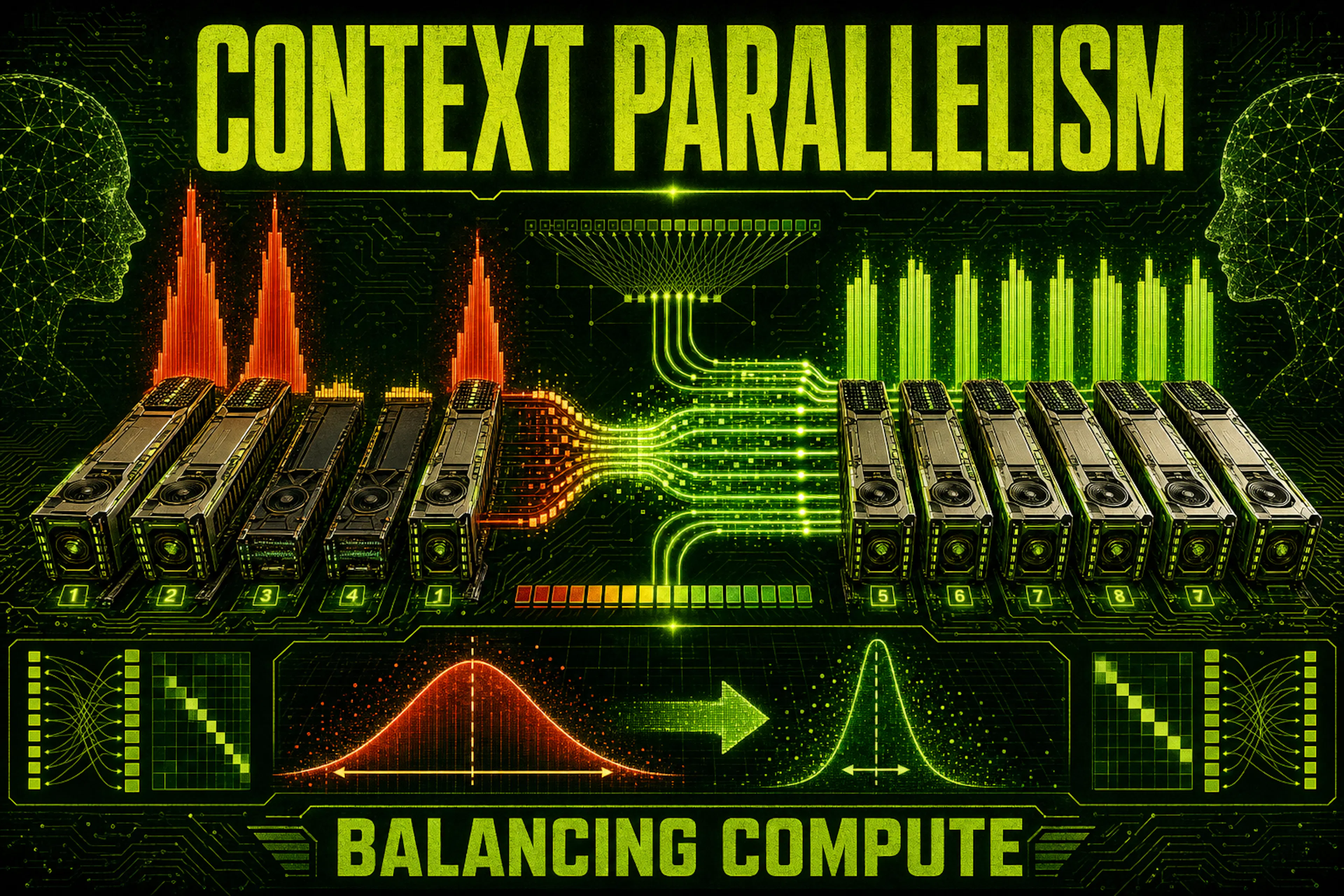
Context parallelism emerges as a critical technique for training large language models with extremely long sequences. By splitting the sequence dimension across multiple GPUs, it reduces per-device memory requirements while preserving the global batch size. This article explores how context parallelism also serves as a powerful mechanism for load balancing during Flash Attention execution.
What Happened
The author introduces context parallelism (CP) as a method that partitions input sequences along the length dimension, allowing each GPU rank to process only a chunk. The post details a computational simulation and real-world benchmarks using Flash Attention 3 on an NVIDIA H100, demonstrating that increasing the CP degree systematically reduces execution time variance across data-parallel groups. Results show that with CP=8, the maximum-to-minimum execution time ratio drops below two, confirming improved load balance.
Why This Matters
In distributed LLM training, iteration speed is dictated by the slowest rank. Even with tensor, pipeline, or context parallelism, gradient synchronization forces all ranks to wait. Small fluctuations in sample length can create severe timing differences because attention computation scales quadratically with sequence length. Context parallelism mitigates this by averaging attention costs across CP ranks, effectively reducing variance and improving overall training throughput.
Key Takeaways
Context parallelism splits sequences across GPUs to lower memory pressure and balances compute variance during Flash Attention. Increasing the CP degree proportionally reduces execution time variance, with theoretical results confirming a 1/CP relationship. Real-world benchmarks on H100 using Flash Attention 3 align closely with predictions, validating CP as a simple yet effective load-balancing baseline. Approaches like batch packing or avoiding heavy-tailed data distributions complement CP, but CP alone provides a strong foundation for scalable training.
Conclusion
Context parallelism offers a practical solution for both memory reduction and load balancing in large-scale LLM training. By distributing sequence chunks across GPUs and averaging attention costs, it reduces variance without complex scheduling. For practitioners aiming to scale training to extreme sequence lengths, CP serves as an essential baseline, especially when combined with careful data packing and appropriate hardware considerations.









Discussion
Join the conversation
Thoughtful reactions, questions, and follow-up ideas help shape the next story.