Introduction
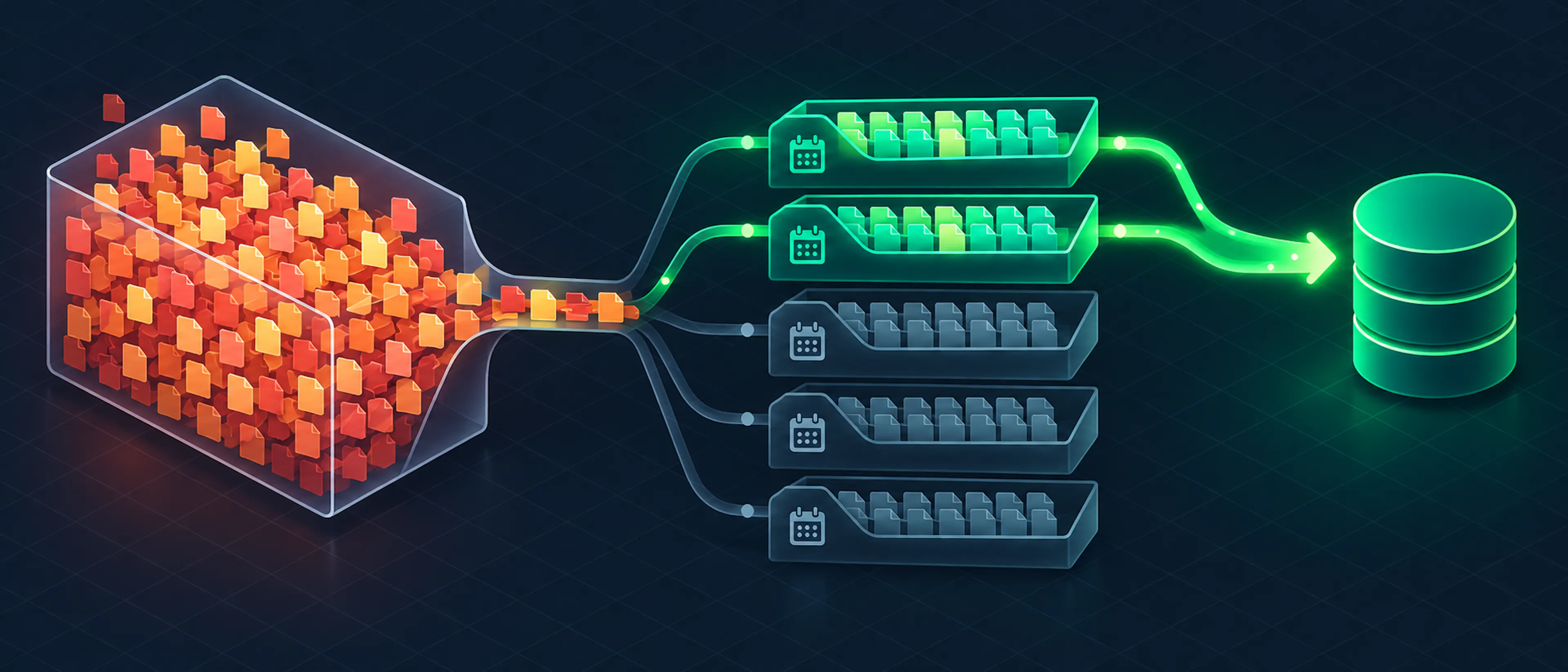
Data ingestion pipelines often appear stable until history accumulates and costs begin to creep upward. When a growing export archive began slowing down job processing, the root cause wasn't compute capacity—it was how files were discovered across an unpartitioned namespace.
What Happened
The ingestion jobs that once completed in minutes started requiring hours. Some exhausted memory entirely, and retrying a failed run repeated the same expensive discovery work. The pipeline had to enumerate every object under a shared prefix, pulling in historical exports alongside new deliveries before it could even begin processing.
Listing object metadata differs from downloading and parsing files, but the enumeration step alone became costly as the key count grew. An implementation that accumulates those keys in memory can fail before ever reaching the actual events. Pagination helps bound memory, but it doesn't eliminate the need to scan historical objects on every run.
Why This Matters
The diagnostic question became clear: did ingestion cost track new data, or did it track everything ever received? In this integration, retained history was baked into the cost of every run. Addressing the source layout with the vendor—rather than building a parallel delivery path—avoided doubling operational overhead while still solving the discovery problem.
Date partitioning changed the access pattern. Instead of enumerating all historical objects, the consumer could target a specific date prefix and process only the relevant window. This made retries, backfills, and day-level recovery practical without scanning the entire archive.
Key Takeaways
- Discovery overhead grows with total object count, not just new data, when using a shared unpartitioned prefix.
- Date-partitioned layouts allow consumers to address only the event-date window needed for a given run.
- Late-arrival policies must accompany partitioning; a partition key based on event date doesn't guarantee completeness without a recovery strategy.
- Preparing the consumer before the vendor ships the new layout prevents rushed implementations and reduces rollout risk.
- Reliable partitioned ingestion depends on both producer changes and consumer readiness, including idempotent writes and durable completion tracking.
Conclusion
Date partitioning didn't just make ingestion faster—it made the pipeline's cost predictable and retries tractable. By reducing the discovery scope from the full history to the active window, the team gained a practical path to reliability without overhauling downstream tables or processes. The experience reinforced that file-based integrations require careful attention to partition semantics, late-arrival handling, and replay behaviour, not just schema compatibility. Working directly with the team on the other side of the interface turned a proposal into a working integration, and the lessons apply wherever file discovery drives pipeline cost.





Discussion
Join the conversation
Thoughtful reactions, questions, and follow-up ideas help shape the next story.