Introduction
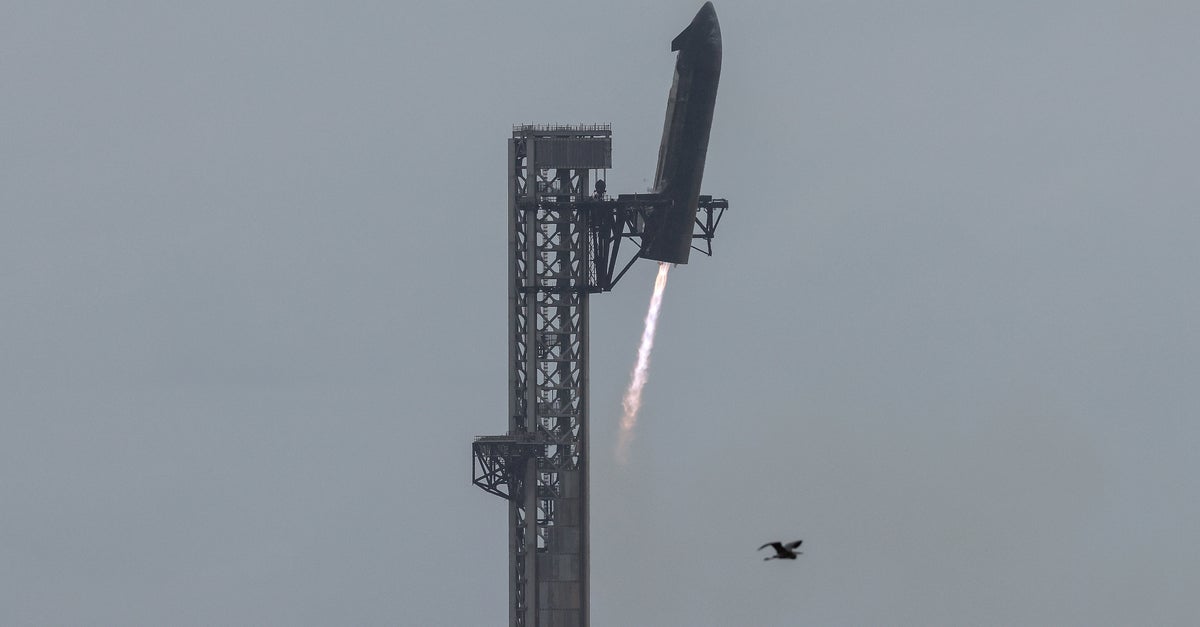
SpaceX has achieved a milestone that once lived only in science fiction. On November 14, 2026, the company’s Starship upper stage returned from orbit and was caught in midair by the mechanical arms of its launch tower at Starbase, Texas. The event marked the first time a Starship spacecraft flying back from space was recovered at the launch site, representing a major advance in fully reusable launch systems. While the companion booster did not survive the return, the successful ship capture demonstrates progress toward rapid, low-cost spaceflight.
What Happened
The 407-foot (124-meter) Starship stack lifted off late Friday afternoon from SpaceX’s facility near the U.S.-Mexico border. Shortly after separation, the upper-stage spacecraft—designated Ship 42—entered orbit and deployed 26 advanced Starlink satellites. It then completed 14 orbits around Earth at an altitude of about 165 miles (265 kilometers), streaming live views back via Starlink.
On Saturday, Ship 42 descended toward the launch pad and was secured by the tower’s giant mechanical arms, hanging upright above the ground. SpaceX commentator Dan Huot captured the moment with an enthusiastic reaction, and CEO Elon Musk later praised the team on social media.
The booster, however, was not recovered. Its engines shut down prematurely during descent, and the vehicle’s guidance system determined it was off course. It automatically diverted to the Gulf of Mexico and self-destructed. Debris remained cordoned off by buoys, and engineers said they were investigating the cause.
Why This Matters
Reusability is central to SpaceX’s long-term strategy. Recovering both the booster and the upper stage at the launch site would allow the company to refurbish and relaunch vehicles quickly, dramatically lowering the cost of access to space. NASA is investing billions in Starship to support the Artemis program, including lunar landings and a sustained presence on the moon. SpaceX also envisions using the vehicle to transport cargo and people toward Mars.
NASA Administrator Jared Isaacman publicly celebrated the catch, describing the moment as nearly magical and signaling growing confidence in the vehicle’s role in national space goals.
Key Takeaways
- Ship 42 became the first Starship upper stage caught at the launch site after returning from orbit.
- The flight marked SpaceX’s 15th full-scale Starship test since 2023 and only its second orbital mission.
- The spacecraft deployed 26 Starlink satellites and completed 14 Earth orbits.
- The first-stage booster was lost after an engine shutdown triggered an automatic destruct sequence over the Gulf of Mexico.
- SpaceX plans to begin Starship launches from Florida’s Kennedy Space Center within months.
- NASA aims for Artemis IV as early as 2028, which would be the first U.S. moon landing since Apollo.
Conclusion
Saturday’s catch is a clear step forward for Starship, even though the booster loss reminds developers how much work remains. Proving that an orbital upper stage can be recovered at the launch pad strengthens the case for rapid reusability, which underpins NASA’s moon plans and SpaceX’s broader interplanetary ambitions. As the company prepares to expand operations to Florida and continues investigating the booster anomaly, the industry will be watching closely to see how quickly this technology moves from test flights to operational service.
Discussion
Join the conversation
Thoughtful reactions, questions, and follow-up ideas help shape the next story.