Introduction
Anthropic is preparing to list on Nasdaq under the ticker ANT, with a roadshow underway and a debut expected before Thanksgiving. The four-year-old AI lab is targeting a valuation near $1.5 trillion, revised downward from an earlier $2 trillion aspiration. Behind the headline number is a faster annualized revenue run rate of roughly $68 billion and a balance sheet carrying more than $300 billion in stock awards for about 1,500 employees.
But the offering is more than a liquidity event. It arrives alongside two other major AI transactions in 2026—SpaceX's acquisition of Cursor and AMD's purchase of World Labs—pushing combined AI deal value past $1.5 trillion in a single quarter. That concentration of capital is exposing a sharp divide in corporate America. On one side are companies rebuilding their operating systems around artificial intelligence. On the other are organizations buying chatbot subscriptions and calling it transformation.
What Happened
Anthropic filed its registration statement in late October 2026 and began marketing shares in early November. The company reports nine-month revenue of about $33.2 billion at an 85.5 percent gross margin, with its most recent quarter alone reaching approximately $17 billion. Net revenue retention sits near 900 percent, and the number of enterprise customers paying six figures annually has jumped from under 1,000 to nearly 12,000 in one year.
The IPO is part of a broader wave. In August, SpaceX acquired Cursor for $60 billion. In September, AMD bought World Labs, the spatial intelligence company founded by Fei-Fei Li, for $8.2 billion. Together with Anthropic's anticipated listing, these transactions represent about $1.57 trillion in AI-related value concentrated into roughly three months.
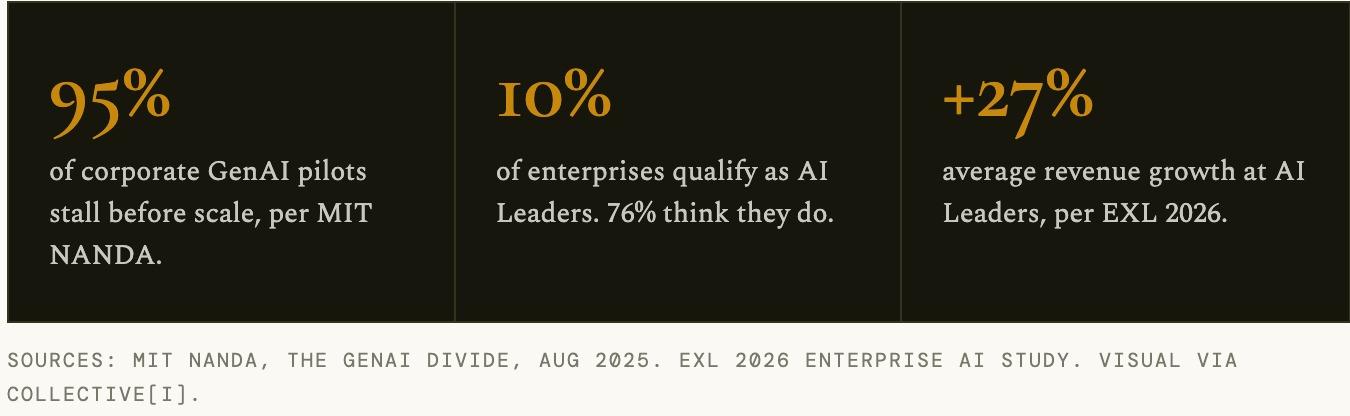
Enterprise data makes the split impossible to ignore. A study from MIT's Media Lab found that 95 percent of generative AI pilots stalled before reaching scale. Separately, an EXL survey of more than 300 senior decision makers found that only 10 percent qualified as true AI leaders, while three-quarters of respondents placed themselves in that category. Those verified leaders reported average revenue growth of 27 percent, cost savings of 26 percent, and margin improvement of 22 percent.
Public statements from AI-first CEOs reinforce the pattern. Shopify's Tobi Lütke instructed teams to demonstrate that AI could not perform a role before approving new hires. Duolingo's Luis von Ahn declared his company AI-first. Klarna's Sebastian Siemiatkowski said an internal agent handled the workload of hundreds of customer service representatives, though the company later walked back parts of that claim. The reversal itself is instructive: even advanced operators must continually recalibrate.
Why This Matters
The central mistake is treating AI as a software subscription rather than a new operating substrate. Buying access to a language model is simple. Rebuilding workflows, decision layers, and customer experiences around multiple model classes is difficult. Companies that stop at the chatbot layer are decorating an old architecture while the foundation beneath them shifts.
Economic history offers context. General purpose technologies such as electricity and computing typically follow a J-curve: productivity dips while organizations invest in intangible capital, then accelerates once that capital compounds. Leaders on the lagging side often see only the initial spending and conclude the early movers are wasting money. By the time the curve bends upward, the gap has become difficult to close.
Talent is moving in the same direction. Anthropic was founded by a group of researchers who left OpenAI, including figures behind GPT-3 and the scaling laws paper. More recently, Andrej Karpathy joined Anthropic to lead pretraining after stints at OpenAI and Eureka Labs. When top researchers can be recruited across the Bay Area to a young competitor, the draw is not just compensation. It is the team, the mission, and the conviction that the model layer is becoming the substrate for the next decade of business.
International competition is also tightening. Stanford's 2026 AI Index placed the leading U.S. model just 39 points ahead of the top Chinese system on a public leaderboard, describing the race as effectively closed. Chinese hardware suppliers are scaling accelerator shipments rapidly, and domestic policy is steering firms toward local chips. A model performing at 97 percent of frontier quality on domestic silicon means Chinese vertical AI startups can deploy capable agents without waiting for imported hardware.
Business history is full of incumbents that ported old operations onto new media and disappeared. Time Warner built a portal for its magazines while Amazon rebuilt retail around the internet. Blockbuster passed on Netflix and later filed for bankruptcy. Sears dominated retail in the early 1990s but could not adapt to e-commerce. In each case, the incumbent preserved the old structure while the newcomer designed a new one.
Key Takeaways
- Most executives overestimate their AI position. Survey data shows a roughly 66-point gap between leaders who believe they are AI-first and those who actually meet the standard.
- Pilot programs are stalling. Research indicates that the vast majority of generative AI experiments never reach production scale.
- Verified AI leaders outperform financially. Organizations classified as AI leaders report significantly higher revenue growth, cost savings, and margin expansion than their peers.
- AI is a stack, not a seat. Winning companies orchestrate language, vision, forecasting, and economic models rather than deploying a single chatbot across every problem.
- Talent concentrates at the frontier. Top engineers and researchers gravitate toward AI-first organizations, leaving legacy vendors with a thinner bench.
- Cycle time is the new moat. Fast companies are reducing idea-to-shipment intervals by double-digit percentages each quarter, while slow organizations measure progress annually and react too late.
Conclusion
The Anthropic listing will force every major board to confront the same question over the coming weeks: if a four-year-old lab can command a $1.5 trillion valuation while engineers walk away with life-changing equity, what is our company actually doing with AI?
A useful diagnostic is whether anyone on the leadership team has personally refactored a core business process to run on AI within the last ninety days, working directly with technical builders. If the answer is no, the organization is likely on the lower side of the divide, and the clock is running faster than quarterly earnings suggest.
History shows that incumbents who port old operations onto new media rarely survive. The companies that rebuild around the new substrate tend to compound. With frontier labs recruiting each other's founders, global model performance converging, and compute infrastructure expanding, the window for catching up is measured in quarters, not years.
Discussion
Join the conversation
Thoughtful reactions, questions, and follow-up ideas help shape the next story.