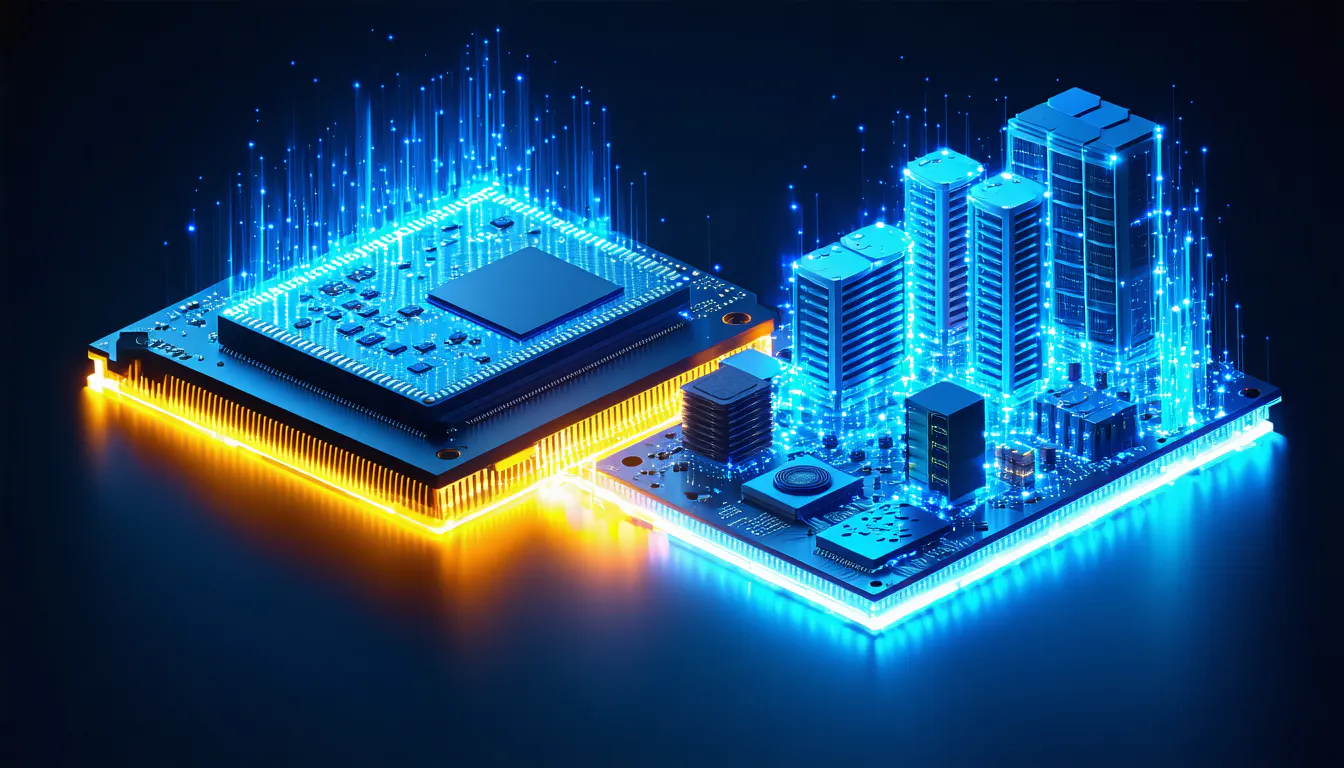
Introduction
\nWhen the cost of computation shifts from transistor count to power budget, every design choice acquires a new weight. In AI systems, the metric that captures this shift is tokens per watt a measure of how much output you get for every unit of energy spent. As context windows grow and agentic workloads expand, the efficiency of each token becomes the difference between scalable systems and spiraling infrastructure costs.
\nWhat Happened
\nTwo decades after Intel cancelled the Tejas and Jayhawk chips because they could not be cooled, the industry faces a familiar inflection point. Gartner projects global data center electricity consumption will reach 565 TWh this year, up from 447 TWh in 2025, with peak power demand hitting 132 GW and climbing toward 290 GW by 2030. AI-optimized servers now consume 31 percent of data center power, and TSMC warns the single most desired improvement across edge mobile IoT and AI data centers is energy efficiency not raw performance. When the constraint moves from how much compute one can buy to how much power can be plugged in, the natural performance metric becomes tokens per watt. A 2026 analytical study known as the 1/W law formalizes the trade-off: every doubling of context length halves the efficiency curve, making context management a first-order power decision rather than an afterthought.
\nWhy This Matters
\nThe implications are most acute for agentic AI. Unlike standard chat interfaces that bound input length, agents accumulate history across every step, re-sending the entire accumulated context with each new request. Gartner places agentic models at five to 30 times more token-hungry than standard GenAI chatbots, and OpenRouter data shows agentic requests consuming roughly 15x more tokens than human queries. A 2026 arXiv paper found agentic coding tasks using nearly 1000x more tokens than standard code reasoning with input tokens not output driving the cost. Compounding the problem, the 1/W law shows that efficiency degrades linearly with context growth: doubling the context window halves tokens-per-watt. This means agentic workloads, which naturally push context lengths upward, slide down the efficiency curve fastest, turning what looks like modest token growth into disproportionate power spend.
\nKey Takeaways
\n- \n
- Q1: Eliminate unnecessary LLM calls. If a schema check, cache lookup, or rules engine can resolve the request, stop. This is clock gating the simplest way to save watts. \n
- Q2: Compress input before sending. Reduce the context length to the minimum the task requires before it ever reaches the model. This moves downstream calls left on the 1/W curve where efficiency gains compound. \n
- Q3: Choose model tiers by quality need, not default size. Assign deterministic lightweight models to routine subtasks and reserve expensive models only for the ambiguous remainder. This mirrors voltage islands running different subsystems at the voltage their work actually requires. \n
- Q4: Enforce a hard token ceiling per task. Set a kill switch and log when the limit is hit. Research shows accuracy often saturates before token counts peak and unbounded loops do not improve outcomes they just inflate the bill. \n
- Fleet-level data reinforces the leverage: two-pool context routing delivers roughly 2.5x better tokens-per-watt a hardware upgrade from H100 to B200 adds roughly 1.7x and because the levers are independent they multiply to nearly 4.25x. Topology consistently beats hardware. For self-hosted fleets splitting context pools roughly doubles efficiency. For API users keeping requests out of the long tail is the equivalent lever. \n
Conclusion
\nThe semiconductor industry learned two decades ago that when watts become the scarce resource efficiency replaces frequency as the headline metric. The AI industry is midway through the same lesson model intelligence is not the constraint power to run inference is, and the architecture that decides how much of that power goes to coordination overhead versus actual output determines whether a system scales sustainably. The single most actionable step is instrumentation join inference telemetry to outcome telemetry report the context-length distribution of every agent workflow and treat context management as a first-class design constraint. Plot your p50 p90 and p99 context lengths. Compress at every subsystem boundary. Gate expensive calls deterministically. Set hard token ceilings. If you internalize these habits tokens per watt stops being a headline number and becomes a predictable design parameter.



Discussion
Join the conversation
Thoughtful reactions, questions, and follow-up ideas help shape the next story.