Introduction
When an AI system makes a high-stakes recommendation, the immediate question is usually whether it is correct. But the more fundamental question where did this decision actually come from is rarely answered. This post explores why tracing AI decisions back to their data origins matters, and how teams can build the infrastructure to make it possible.
What Happened
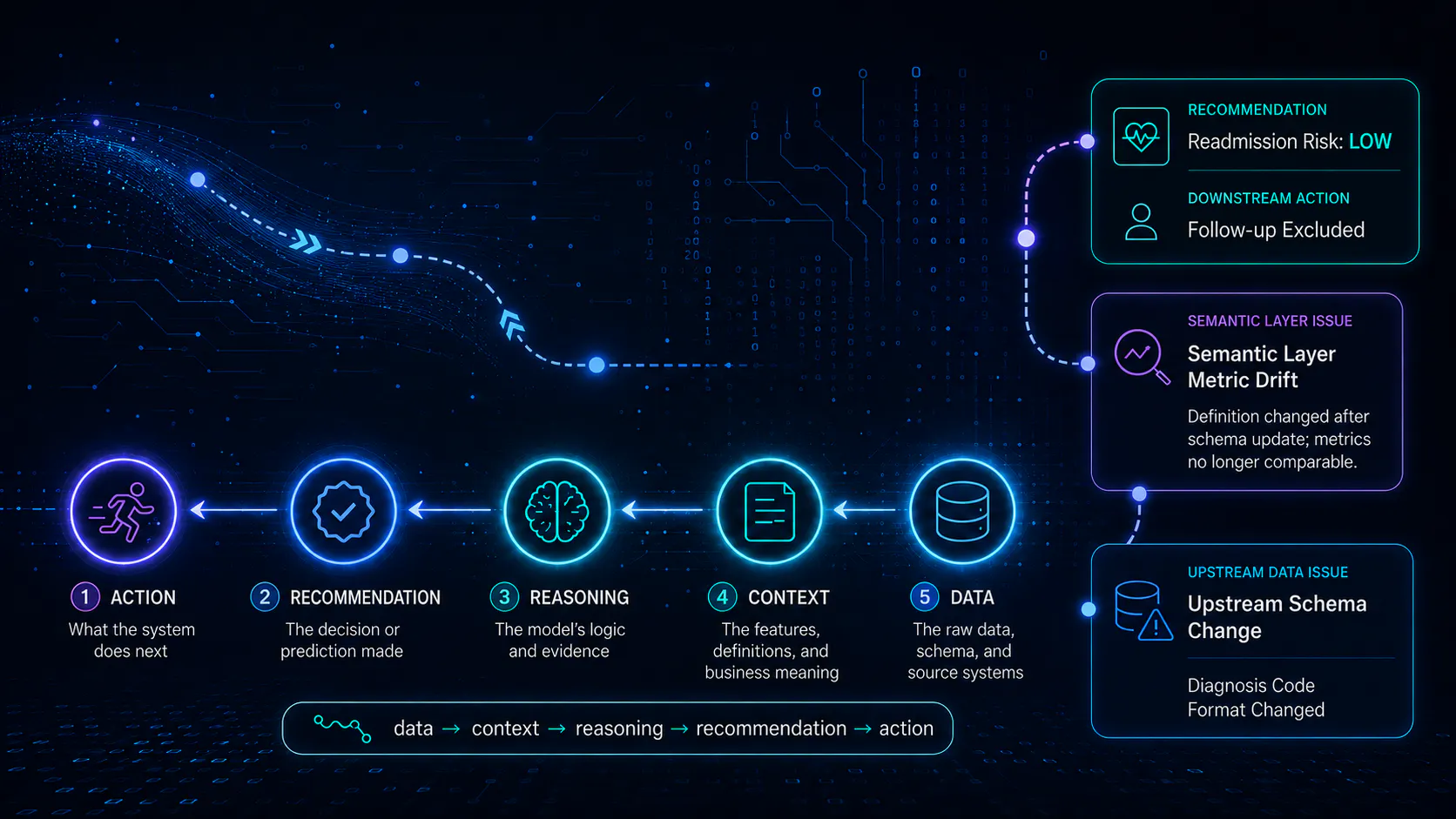
A real-world healthcare analytics failure illustrates the risk. A readmission-risk model flagged patients as low-risk, excluding them from a follow-up program. The model itself appeared sound, but the signal came from a silently drifting semantic metric. Tracing backward revealed a chain of subtle issues across data, context, and logic, none broken individually, but together producing a decision no one would approve even if they had seen the full picture.
Why This Matters
Most teams can show you the model output or the training data, but few can walk the full path from a specific decision back to the exact data point, context signals, reasoning logic, and resulting action that produced it. This gap becomes critical under regulatory pressure, customer scrutiny, or internal review. Tracing is not just about transparency; it is about accountability when the cost of an unexplainable decision is high.
Key Takeaways
- Fingerprint every recommendation with a composite ID linking the exact data snapshot, semantic layer version, feature version, and model version involved.
- Treat the semantic layer as a first-class citizen with its own lineage and version history, so drifts show up as traceable changes, not unexplained shifts.
- Explicitly log deviations when humans or downstream systems override recommendations, rather than silently merging them into what happened
- Make the trace chain queryable by non-engineers such as clinicians or compliance analysts; if tracing only works when a data engineer is present, it does not really work
Conclusion
If you cannot trace how a specific decision your system made last week connects back to the data behind it, start there. Pick one monthly recommendation and see how far back you can walk it. That single exercise reveals more about your AI readiness than any benchmark. Tracing does not make a decision better. It makes it accountable, and that is the conversation that actually fixes things.



Discussion
Join the conversation
Thoughtful reactions, questions, and follow-up ideas help shape the next story.