Introduction
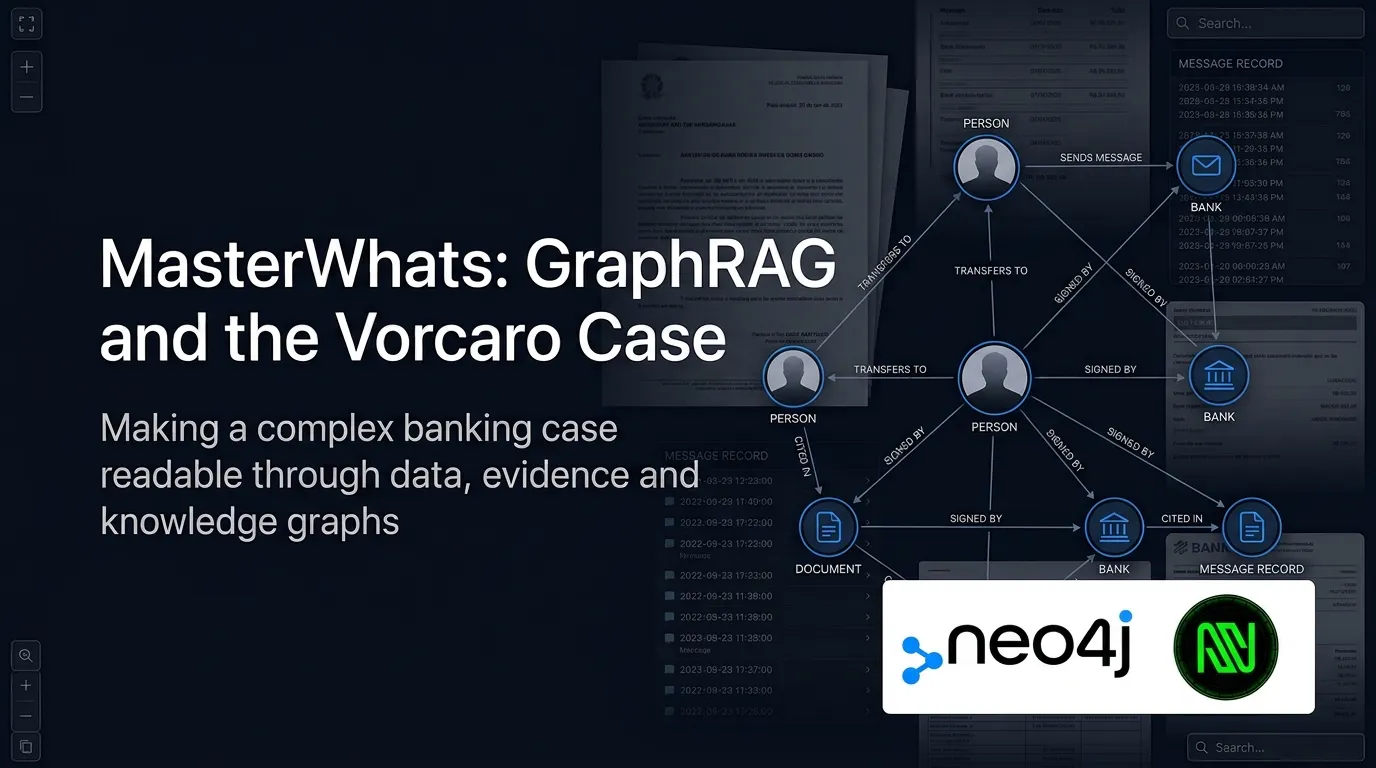
MasterWhats turns Brazil's biggest banking fraud into a searchable, transparent story that anyone can explore without reading hundreds of articles. Built by a small Brazilian team, it organizes people, institutions, and leaked messages into a structured interface powered by graph technology.
What Happened
In November 2025, Brazil's Central Bank ordered the extrajudicial liquidation of Banco Master after it sold roughly R$50 billion in government-backed deposit certificates. The bank's rapid growth rested on illiquid assets like court-ordered payment rights and stakes in struggling companies. Its controller, Daniel Vorcaro, was arrested on money-laundering charges. Leaked message threads allegedly show Vorcaro in direct contact with Central Bank staff, judiciary members, and political figures across the ideological spectrum, apparently trying to soften or delay regulatory action. Within weeks, dozens of names, institutions, and message threads circulated across news sites, PDFs, and social media, each outlet publishing a different fragment of the same underlying network -- a hard shape of problem for the public to hold in their heads.
Why This Matters
A financial fraud with an evolving cast of forty-plus people, examined through hundreds of individual messages scattered across dozens of articles, is exactly the kind of information environment where confusion, rumor, and cherry-picked screenshots thrive instead of understanding. MasterWhats addresses this structural problem: once a dozen outlets have each published their own fragment of the network, there's no single place for someone to seek connections and receive answers grounded in a specific citable source, plainly when evidence doesn't support a conclusion, and without requiring reading forty articles first. It's a meaningfully different kind of access than a search engine or single explainer article provides -- closer to what investigative newsrooms build internally for large document leaks, made available as a public tool.
Key Takeaways
- MasterWhats uses a GraphRAG pipeline to organize people, institutions, messages, and source documents into a queryable knowledge graph.
- The system embeds evidence with a multilingual sentence-transformer and grounds a quantized LLM strictly in retrieved chunks, refusing to answer when evidence is insufficient.
- It runs on Nosana's decentralized GPU marketplace, making advanced inference affordable for bootstrapped, self-funded teams.
- Every answer includes its source, and uncertain connections are explicitly flagged as hypotheses with confidence levels, not verdicts.
- The tool doesn't replace investigative journalism but fills a structural need: a public queryable index after the initial reporting frenzy.
Conclusion
MasterWhats demonstrates that graph-based knowledge tools, paired with decentralized compute, can turn chaotic leak dumps into navigable public resources. As financial and political scandals continue to generate fragmented, leak-heavy narratives, citizen-accessible indexes may become essential for accountability without requiring a newsroom budget. The team's roadmap includes integrating Neo4j for combined semantic search and graph traversal, adding confidence-auditing passes, and exposing a public API for an ask-the-graph feature. The broader bet is that small teams with a graph, a modest open model, and access to affordable decentralized compute can build public infrastructure for understanding complex scandals, without needing a newsroom's budget or a cloud contract.



Discussion
Join the conversation
Thoughtful reactions, questions, and follow-up ideas help shape the next story.