Introduction
For nearly a year, Angelie Xiong lived with a kitchen she described as “boring millennial gray.” The neutral space in her New York City studio apartment felt blank and uninspiring, but she assumed any makeover would require too much time, money, or permanent changes. Eventually, she decided to stop waiting and redesign the room on her own terms.
What Happened
Before touching a paintbrush, Xiong used AI image generation to experiment with color schemes and visualize the finished look. She settled on a daring burgundy and deep red palette, embracing an all-in mindset.
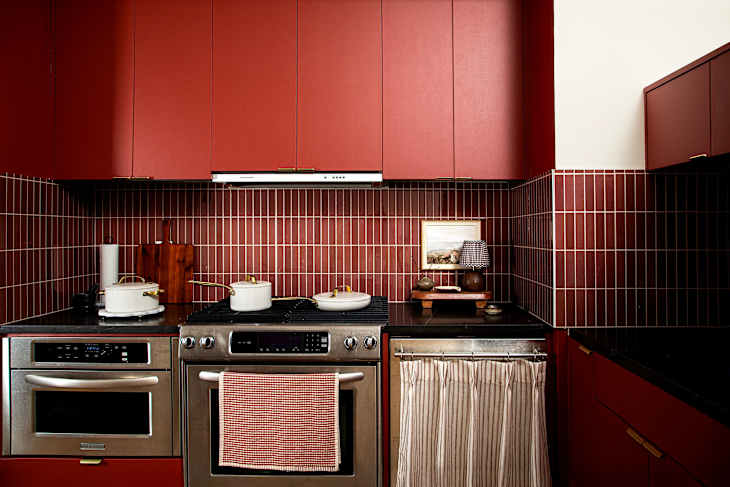
Her first step was wrapping the cabinet doors in peel-and-stick “brick red” contact paper, a technique she had already practiced on her bathroom cabinets. She then painted the wall behind the cabinets in Behr’s “Moroccan Ruby,” intentionally leaving adjacent walls untouched so the color would feel like a defined nook rather than overwhelming the entire studio.
Small hardware swaps completed the cabinet update. She replaced the original handles with gold ones and hung a beige cafe curtain over the dishwasher to hide its stainless steel front while adding soft texture.
The backsplash proved to be the toughest part of the project. Because the existing surface was uneven, she could not apply peel-and-stick tiles directly. After ruling out thin metal sheets as too costly and plywood as too bulky, she chose affordable, lightweight PVC boards. She cut the boards to match the backsplash shape, glued them in place, and topped them with “cinnamon red” peel-and-stick 3D tiles.
Across from the kitchen, her dining area received a solid wood table, rattan chairs, and a plug-in pendant light suspended from a wall-mounted pole so she could center it without hardwiring. She is still searching for wall art to finish the space.
Why This Matters
Renters often feel stuck with dated kitchens because leases restrict major renovations. Xiong’s project shows that high-impact design is possible without painting every wall, replacing appliances, or risking a security deposit. Temporary materials like contact paper, removable tile, and plug-in lighting make it possible to personalize a rental and reverse the changes when moving out.
Key Takeaways
- AI tools can help renters visualize color choices before committing to paint or materials.
- Painting only one wall can create a cozy kitchen nook without dominating a small apartment.
- Peel-and-stick contact paper is an affordable way to refresh cabinet doors.
- Uneven backsplashes may need a smooth backing board, such as PVC, before removable tiles can be applied.
- Gold hardware, cafe curtains, and plug-in pendant lights add style without permanent installation.
Conclusion
Angelie Xiong’s kitchen is no longer a gray afterthought. The bold red nook feels contained and intentional, giving her a vibrant space she enjoys seeing every day. Her experience is a practical reminder that renters can transform a kitchen with budget-friendly, renter-friendly DIYs—no landlord approval required for most of the updates.
Discussion
Join the conversation
Thoughtful reactions, questions, and follow-up ideas help shape the next story.