Introduction
Dictation seems like a solved problem until you actually build one. What appears as a straightforward transcription task unravels into architecture trade-offs, billing surprises, and model-layer confusion. This post walks through the real decisions behind low-latency speech pipelines, from browser APIs to synchronous dictation endpoints, and why the obvious choices often fall short.
What Happened
In August 2026 Wispr announced a 280 million raise at a 2 billion valuation and The New York Times Magazine simultaneously published a scathing review of its dictation app. The reviewer described transcripts that needed as much editing as she saved concluding the technology was not ready. The frustration reflected three distinct failure modes: recognition errors in noisy conditions, a fragile cleanup layer that mishandles speech disfluencies, and the fundamental gap between spoken language and structured writing. Wispr itself acknowledged error rates above 30 percent in hard conditions noise accents music and previewed a new model to bring them down.
Why This Matters
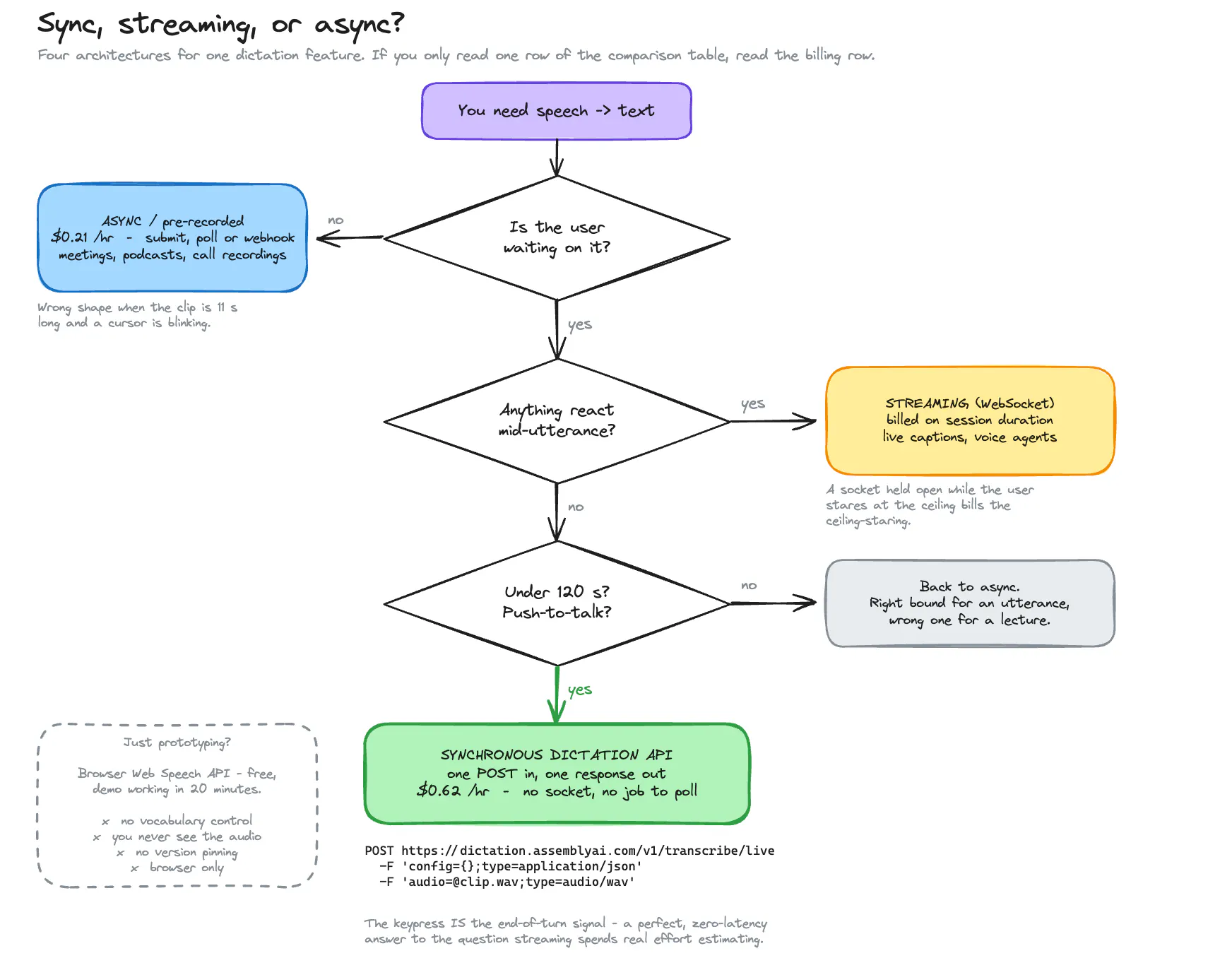
The reviewer pain points trace back to decisions made before a single word is transcribed. Most users experience dictation failure not from bad hearing but from mismatched architecture: streaming APIs billed by the second even when the user pauses job queue APIs that feel wrong for eleven-second utterances and browser APIs that lock you into a single platform with no vocabulary control. This post examines four architectural patterns the cost implications of each and how the new synchronous dictation API reframes the trade-offs between latency price and developer control.
Key Takeaways
- The browser Web Speech API is free and fast to prototype but offers no model control no vocabulary biasing and inconsistent behavior across browsers unsuitable for production dictation
- Streaming APIs deliver partial hypotheses and end-of-turn detection which suit live captions and voice agents but charge by session duration meaning you pay for silence when a user pauses to think
- Async job submission APIs work well for hour long recordings but feel awkward for short interactive dictation where the user waits for a response
- The Dictation API introduced in September 2026 provides a synchronous single request workflow capped at 120 seconds accepting only WAV or raw 16 bit PCM and returns both a raw transcript and an LLM refined version
- Pricing diverges sharply consumer subscriptions start at 15 per month for unlimited dictation while the API charges 0.62 per hour roughly 3.10 for a developer speaking 14 minutes a day
- Developers building their own cleanup layer must guard against prompt injection since spoken commands like ignore what I just said or translate this to French can execute if not properly fenced
- The real frontier is not better models alone but figuring out where the editorial layer lives separating recognition from prose shaping
Conclusion
The real interest in dictation over the coming year likely is not in better models alone but in figuring out where the editorial layer lives. The open source dictation app Blurt built on the Dictation API demonstrates how a single synchronous POST can power native macOS dictation without Electron overhead. For anyone integrating speech into a product the path forward is clearer choose the right architecture for the interaction model guard against prompt injection and remember that accurate recognition is only the first step toward useful voice input.



Discussion
Join the conversation
Thoughtful reactions, questions, and follow-up ideas help shape the next story.