Introduction
Astronomers have witnessed a rare and violent stellar event in the Andromeda galaxy, located roughly 2.5 million light-years from Earth. A massive red giant star expanded until it engulfed a smaller companion, producing a brilliant flash that researchers tracked from first brightening to final eruption. The discovery, detailed in the journal Nature, offers scientists an unprecedented real-time look at how binary star systems can end in a cosmic merger.
What Happened
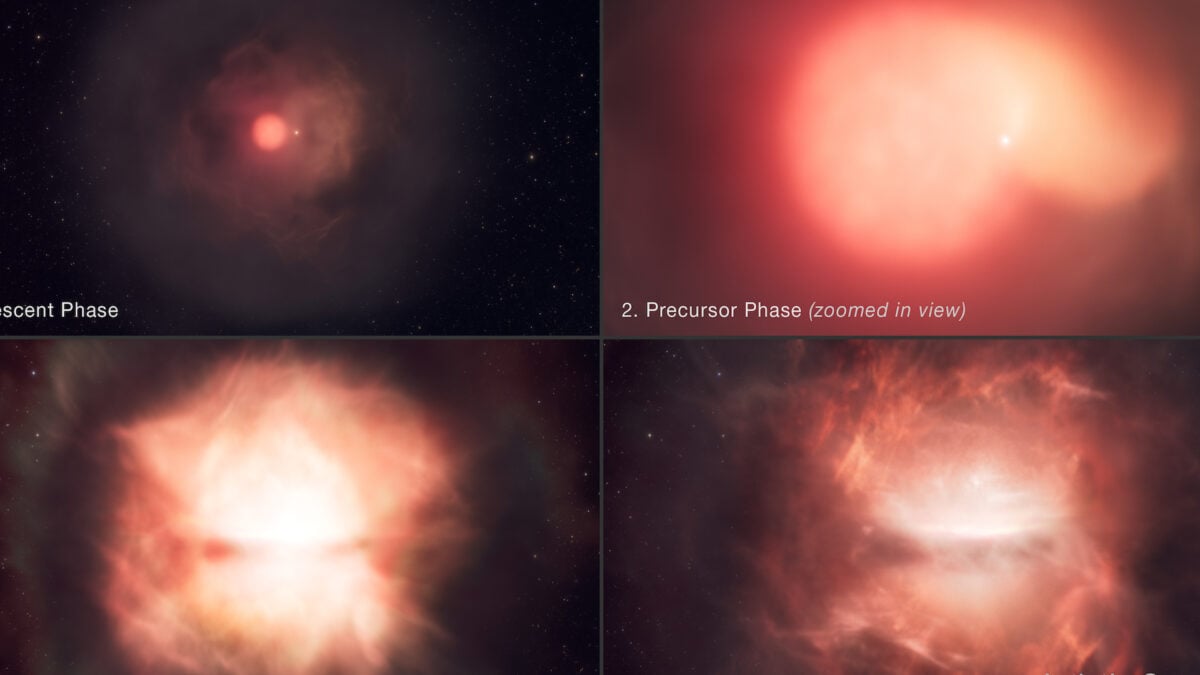
The event, designated AT2025abao, began drawing attention in 2023 when observers noticed a red giant steadily growing brighter. Over two years, astronomers using Caltech’s Palomar Observatory and other global facilities monitored the star as it continued to intensify. The larger star, nicknamed Big Bao, is about seven times the mass of the Sun and shines roughly 18,000 times more brightly. Its smaller partner, Small Bao, measured approximately 70 percent of the Sun’s diameter.
As Big Bao expanded, its companion spiraled inward. In fewer than ten orbits, Small Bao plunged into the red giant’s core. By October 2025, the collision triggered an eruption roughly a million times brighter than the Sun. Follow-up observations showed that about 10 percent of the larger star’s outer envelope of gas and dust was blown away in the blast.
Why This Matters
Stable stars like these can persist for thousands of years without dramatic change, so catching a merger as it unfolds is exceptionally rare. Lead researcher Viraj Karambelkar, a NASA Hubble Fellow at Columbia University, said the team could hardly believe they were observing such an event in their lifetimes. Co-author Mansi Kasliwal, director of Palomar Observatory, noted that combining data from multiple observatories allowed them to confirm a smaller star had crashed into the core of its larger companion.
Beyond the spectacle, the observation helps refine models of stellar evolution and binary interactions. It shows how mass transfer and direct collisions can reshape aging stars and alter their surroundings, providing clues about similar systems elsewhere in the universe.
Key Takeaways
- The merger took place in the Andromeda galaxy, about 2.5 million light-years from Earth.
- A red giant nicknamed Big Bao consumed a smaller companion called Small Bao.
- The event, known as AT2025abao, produced an eruption roughly a million times brighter than the Sun.
- Astronomers tracked the brightening for two years using Palomar Observatory and other facilities.
- Approximately 10 percent of the red giant’s outer envelope was ejected during the explosion.
- The findings were published in Nature by a team led by Viraj Karambelkar and Mansi Kasliwal.
Conclusion
The story of Big Bao and Small Bao marks just one chapter in a broader investigation into how stars live, die, and interact. By capturing a stellar merger from beginning to end, researchers now have a detailed reference point for understanding the violent transformations that can occur in binary systems. As astronomers continue to monitor the aftermath, this event may help unlock new insights into the life cycles of stars across the cosmos.
Discussion
Join the conversation
Thoughtful reactions, questions, and follow-up ideas help shape the next story.