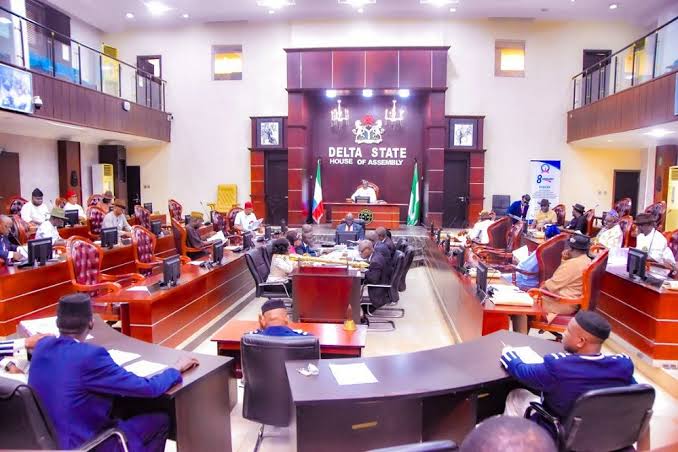
The Delta State House of Assembly has approved a spending plan for the 2027 fiscal year, setting the total at N1.272 trillion. The legislation directs a larger share of resources toward capital projects, with lawmakers voting to pass the measure during a plenary session in Asaba. The bill now moves to the executive for final approval.
What Happened
Lawmakers passed the appropriation bill by voice vote at a sitting led by Speaker Dennis Guwor. The total allocation stands at N1.272 trillion, exceeding the N1.23 trillion originally submitted by Governor Sheriff Oborevwori in mid-November. Recurrent spending remains fixed at N430 billion, while capital expenditure rises from N806.8 billion to N842 billion, an increase of N35.2 billion.
Marilyn Okowa-Daramola, who chairs the House Committee on Finance and Appropriation and represents Ika North-East, presented the report. She said the extra funds are earmarked for priority infrastructure projects intended to improve living standards and stimulate economic activity across the state.
The budget framework also reflects the administration's focus on education, agriculture, healthcare, industrialisation, and youth empowerment. Specific emphasis was placed on agricultural production and processing, food security, quality healthcare access, and skills development for young people.
Majority Leader Emeka Nwaobi of Aniocha North moved the motion for adoption, with Festus Okoh of Ika South seconding it. Nwaobi also moved the third reading, which was seconded by Perkins Umukoro of Sapele. After the voice vote, Speaker Guwor instructed that a clean copy be sent to Governor Oborevwori for assent.
Why This Matters
The approval signals Delta's commitment to prioritising physical infrastructure over routine administrative costs. By directing more than half of the total budget to capital expenditure, the state aims to accelerate road construction, healthcare upgrades, agricultural value chains, and job creation initiatives.
The move also places Delta alongside other Nigerian states that are finalising their 2027 spending plans. Katsina has already signed its N828.58 billion budget into law, while Abia, Akwa Ibom, Osun, Anambra, and Yobe are at various stages of presenting or approving their own proposals. The Delta bill remains pending until the governor signs it.
Key Takeaways
- The Delta State House of Assembly passed a N1.272 trillion budget for the 2027 fiscal year.
- Capital expenditure was increased by N35.2 billion to N842 billion.
- Recurrent expenditure was retained at N430 billion.
- The approved figure is higher than the N1.23 trillion proposal sent by the governor.
- The bill passed by voice vote under the leadership of Speaker Dennis Guwor.
- Marilyn Okowa-Daramola presented the committee report on behalf of the House Committee on Finance and Appropriation.
- Priority sectors include education, agriculture, healthcare, industrialisation, and youth empowerment.
- The legislation awaits Governor Sheriff Oborevwori's assent to become law.
Conclusion
Delta's 2027 appropriation bill reflects a deliberate shift toward capital-driven growth, with lawmakers approving N842 billion for infrastructure and development projects. The measure now rests with the executive branch, and its eventual assent will determine when the spending plan takes effect. As other states across Nigeria advance their own 2027 budgets, Delta's legislative action adds to the broader picture of subnational fiscal planning ahead of the new fiscal year.
Discussion
Join the conversation
Thoughtful reactions, questions, and follow-up ideas help shape the next story.