Introduction
In late 2022, NASA deliberately crashed a spacecraft into a small asteroid to test whether a high-speed impact could push a hazardous space rock off a collision course with Earth. Now, the European Space Agency's Hera probe has reached the crash site and transmitted the first detailed post-impact imagery. The photographs show that the collision did far more than alter the asteroid's orbit—it fundamentally reshaped the body itself.
What Happened
NASA's Double Asteroid Redirection Test, known as DART, struck Dimorphos on September 26, 2022, traveling at roughly 15,000 miles per hour. Dimorphos is a 558-foot-wide moonlet that orbits the larger asteroid Didymos, which spans about 2,625 feet across. The impact shortened Dimorphos's orbital period around Didymos by 33 minutes, offering proof that asteroid deflection is physically achievable.
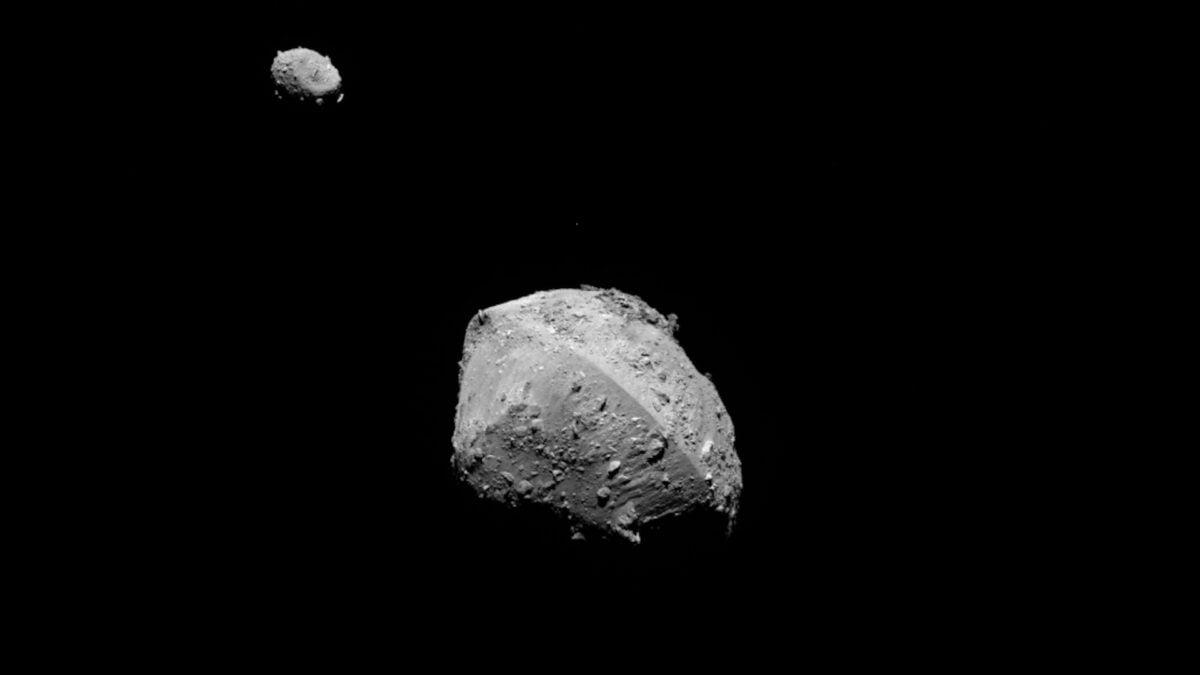
Hera launched on October 7, 2024, and arrived at the binary asteroid system shortly before these images were made public. Flying roughly 19 miles from Dimorphos, the car-sized spacecraft captured views showing a stadium-sized crater on the side that absorbed the blow. That impact zone is nearly as wide as the asteroid itself and has left one face visibly flattened. The crash also sent Dimorphos into an unstable tumble and blasted hundreds of boulders loose, which now drift around the two-rock system.
Why This Matters
Telescopes on Earth confirmed that DART changed Dimorphos's orbit, but they could not reveal what the impact did to the asteroid's surface or internal structure. Hera's close-up observations close that gap. Researchers initially debated whether the strike left a crater, changed the asteroid's shape, or left it mostly intact. The new imagery indicates the answer involves all three outcomes.
Understanding the physical aftermath is essential for turning a one-time experiment into a dependable planetary defense strategy. If Earth ever faces a threatening asteroid, planners will need to know not only whether an impactor can change an object's path, but also how the target body will react structurally.
Key Takeaways
- NASA's DART spacecraft impacted Dimorphos in September 2022 at about 15,000 miles per hour.
- ESA's Hera mission reached the asteroid system in 2024 and returned the first close-up images of the impact site.
- The collision created a stadium-sized crater and flattened one side of the 558-foot-wide asteroid.
- Dimorphos is now tumbling chaotically, and hundreds of boulders surround the Didymos system.
- Hera plans to deploy two small satellites, Milani and Juventas, in early 2027 to study surface composition and interior structure.
Conclusion
The Hera investigation is still in its early stages. Over the next six months, the spacecraft will move closer to both asteroids and release its miniature companions to gather additional data. Together, DART and Hera are providing a start-to-finish picture of asteroid deflection, bringing humanity closer to a reliable method for protecting the planet from future impact threats.
Discussion
Join the conversation
Thoughtful reactions, questions, and follow-up ideas help shape the next story.